One year after 'Liberation Day': Trump tariffs cost Belgian tech firms 1,500 jobs and €70m in investment

Companies increasingly pivot towards exports within the EU
The most immediate effect of the Trump tariffs was the decline in exports of technology goods in 2025. Our country exported 7% fewer technology products to the US. The technology sector, which exports a staggering half of its turnover – € 84 billion – is hit twice by these trade tariffs. Once by the general duties, and again by the additional tariffs on copper, steel and aluminium. These run up to 50%.
However, the general uncertainty sparked by the trade war also weighs heavily. Technology companies are seeing a lack of investment in other European and Belgian sectors to which they would normally supply. This uncertainty therefore affects them twice: directly and through their customers. .
Moreover, the uncertainty caused by the measures weighs even more heavily than the tariffs themselves: 67% of the nearly 200 companies surveyed have scaled back their recruitment plans, and 41% are postponing future-oriented investments.
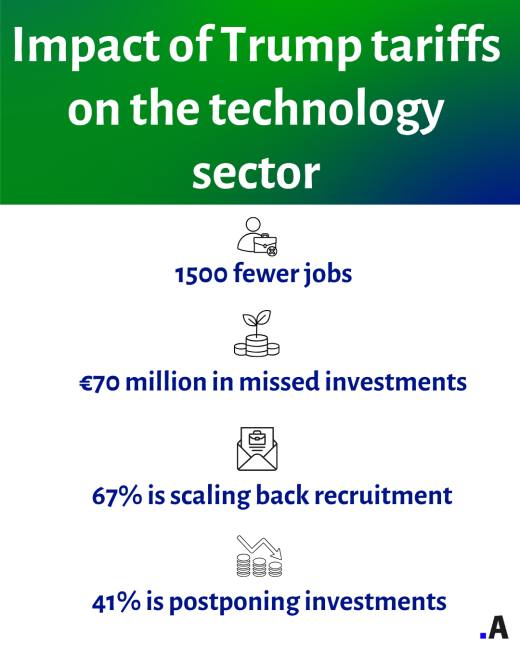
“Our technology companies have paid a heavy price for this trade war, losing out on 1,500 jobs and €70 million in postponed investments. The uncertainty is placing a severe strain on our growth. Two-thirds of technology companies are scaling back recruitment and four in ten are postponing future-oriented investments. They are becoming increasingly risk-averse and are clearly pulling the handbrake,” says Bart Steukers, CEO of Agoria.
Companies in mass search for new markets
Despite the challenges, despair is not the prevailing sentiment. Companies are adjusting their strategies: 25% plan to reduce exports to the US next year due to the trade tariffs. However, this retreat is being met with an offensive move: 66% are actively engaged in diversification. The preference is overwhelmingly for exports within the European Union. This shift was already evident last year: while exports to the US fell by 7%, those to EU countries rose by 2.5%. Three-quarters (73%) of the companies surveyed intend to further ramp up these European exports in the coming year.
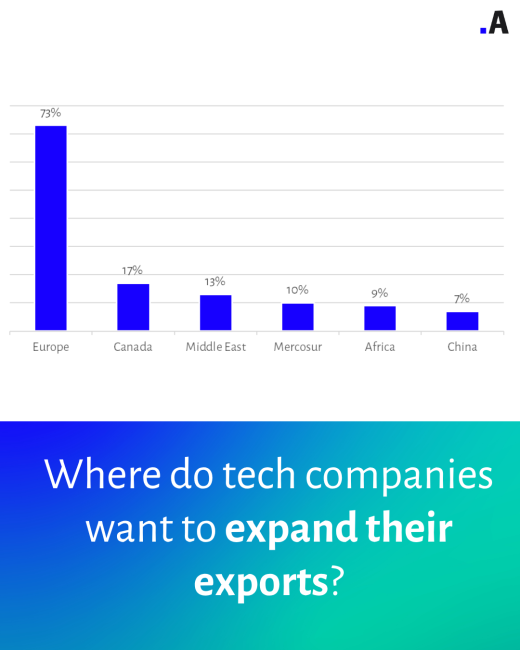
Where do technology companies intend to increase their exports in 2026?
The trade agreements with Canada and Mercosur have secured those export destinations a place in the top 5.
We must finalise those agreements, as well as those with Australia, Mexico and others, as soon as possible. However, a well-functioning European Single Market is the most powerful protection we can offer our companies. Today, fragmented regulation within the EU is an even greater bottleneck for trade than the Trump tariffs themselves.
Bart Steukers, CEO of Agoria

European potential underutilised
That European potential remains untapped as long as companies are faced with a complex mix of national rules and administrative obligations. Agoria is therefore calling on the European institutions and the Belgian authorities to take concrete action. The technology federation identifies three priority measures:
- Ratify and implement the announced trade agreements as soon as possible.
- Ensure more uniform regulation within the EU. The Single Market is a single entity on paper, but in practice, technology companies face a patchwork of national interpretations. This applies, among other things, to digital legislation such as GDPR (data protection) and NIS2 (cybersecurity); to the transport and processing of critical raw materials and recycled metals; and to the energy market, where taxes, subsidy schemes, and permitting procedures vary significantly from country to country.
- Opening doors for companies with trade missions to the destinations they identify as most interesting.
About the survey
This survey was conducted by Agoria among 194 Belgian technology companies from 9 to 17 March 2026.


